Multimodal agents
Overview
Nex is a new generation of agentic models, with the Shanghai Innovation Institute and MOSS as core research and development contributors, co-developed and jointly released with innovative partners.
The Nex-N2.5 series was released in September 2026. Built around seeing and acting, it moved beyond text conversations to deliver practical screen understanding and control of real computer interfaces, reaching the top of OpenRouter's trending model rankings upon release.
Following the community response to N2.5, the team refined computer-use and tool-calling capabilities and released Nex-N2.6 in November 2026. For long-running tasks, its reasoning repetition rate fell by 90% compared with N2.5, substantially reducing token consumption. In cross-harness adaptation, it achieved zero invalid tool selections in the reported evaluation, matching GPT-6-Sol. This marks a step forward in reliable delivery of long-running tasks.
Nex-N2.6 accepts text, images, and video and produces text. Its API supports a 256K context window, and FP8-quantized weights for the 321B-parameter model are openly available.
Lower token consumption and more reliable long-running tasks: repeated failures down 90%
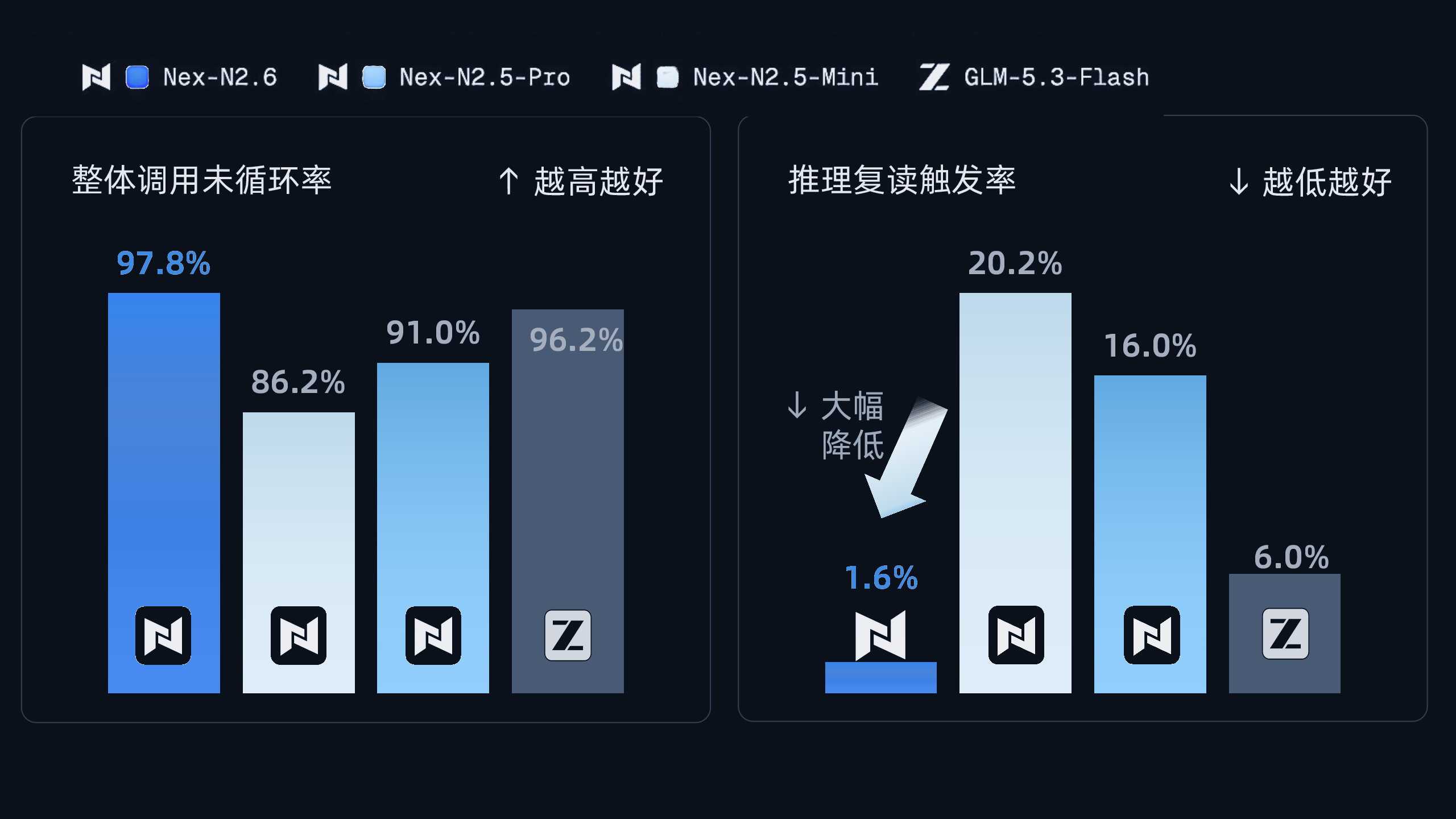
To evaluate the upgrade, the team assembled an internal repeated-issues benchmark from 698 failure cases collected by its own teams and partners. The evaluation used Checkpoint Replay: the history and tool results immediately before an earlier model failed or stalled were frozen, and Nex-N2.6 generated its next response from the same checkpoint. Holding this context fixed removes the randomness of choosing a new trajectory from the beginning and provides an engineering measure of failure recovery. Compared with N2.5-Pro, Nex-N2.6's reasoning repetition trigger rate fell by 90%, from 16.0% to 1.6%, while its overall non-looping call rate reached 97.8%. The team reports that avoiding repeated reasoning reduces wasted tokens and improves end-to-end task completion.
| Metric | N2.5-mini | N2.5-Pro | GLM-5.3-Flash | N2.6 |
|---|---|---|---|---|
| Reasoning repetition trigger rate | 20.2% | 16.0% | 6.0% | 1.6% |
| Overall non-looping call rate | 86.2% | 91.0% | 96.2% | 97.8% |
Cross-harness adaptation: 100% valid tool selection, matching GPT-6-Sol
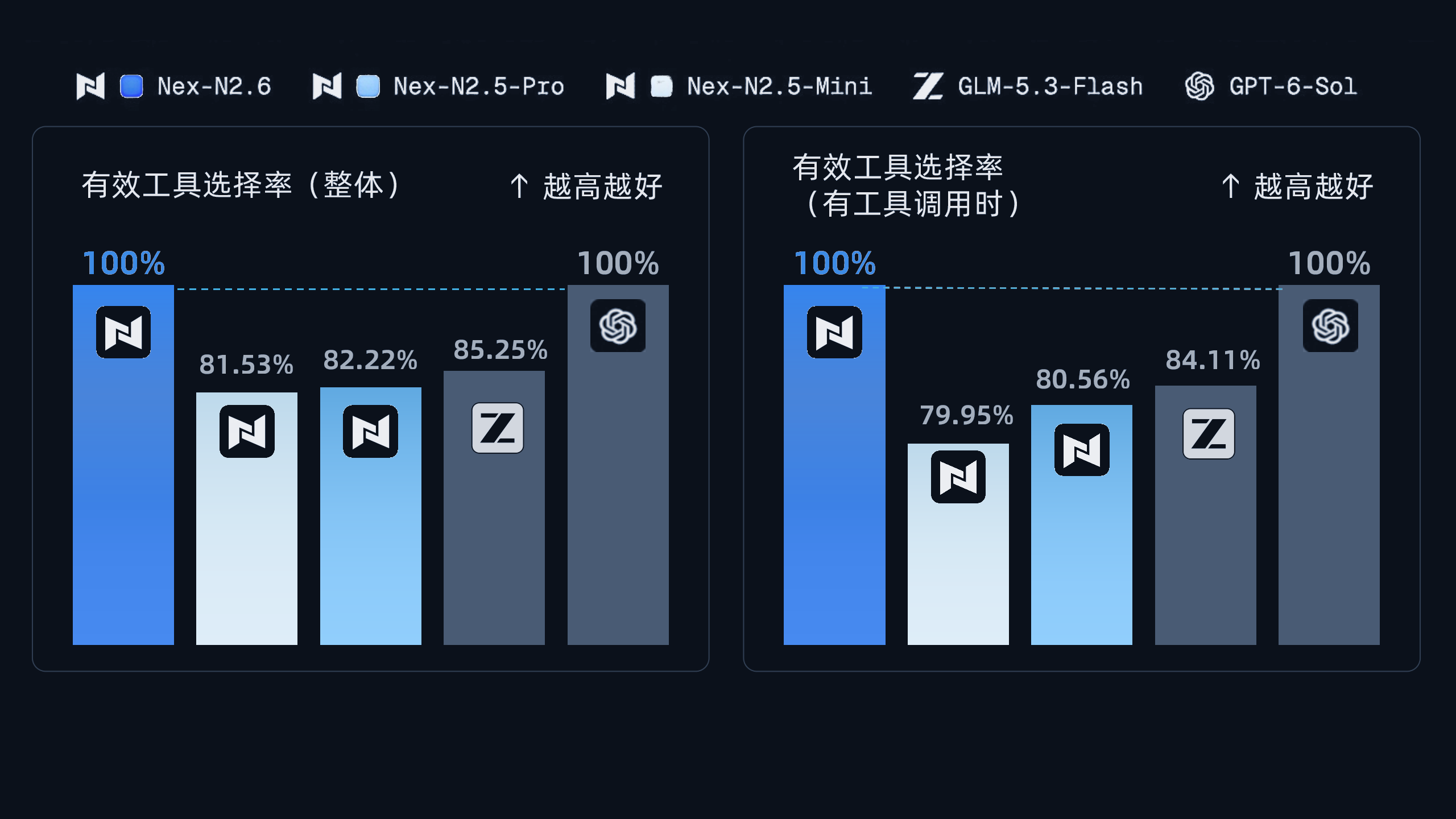
Developers frequently switch between harnesses, runtime frameworks, and environments. A harness declares the tools available to the model. Tool names recorded in conversation history can differ from those in a new framework, such as read_file versus open_file, leading to errors. The team evaluated 956 real contexts spanning Claude Code, Codex, Cursor, and custom harnesses. Both valid tool selection metrics reached 100%, matching GPT-6-Sol. The reported results indicate improved adaptation across harnesses and reduced dependence on a particular training environment.
| Model | Valid tool selection rate (overall) | Valid tool selection rate (when tools are called) |
|---|---|---|
| N2.5-mini | 81.53% | 79.95% |
| N2.5-Pro | 82.22% | 80.56% |
| GLM-5.3-Flash | 85.25% | 84.11% |
| N2.6 | 100.00% | 100.00% |
| GPT-6-Sol (reference) | 100.00% | 100.00% |
Stronger computer use: improved OSWorld performance
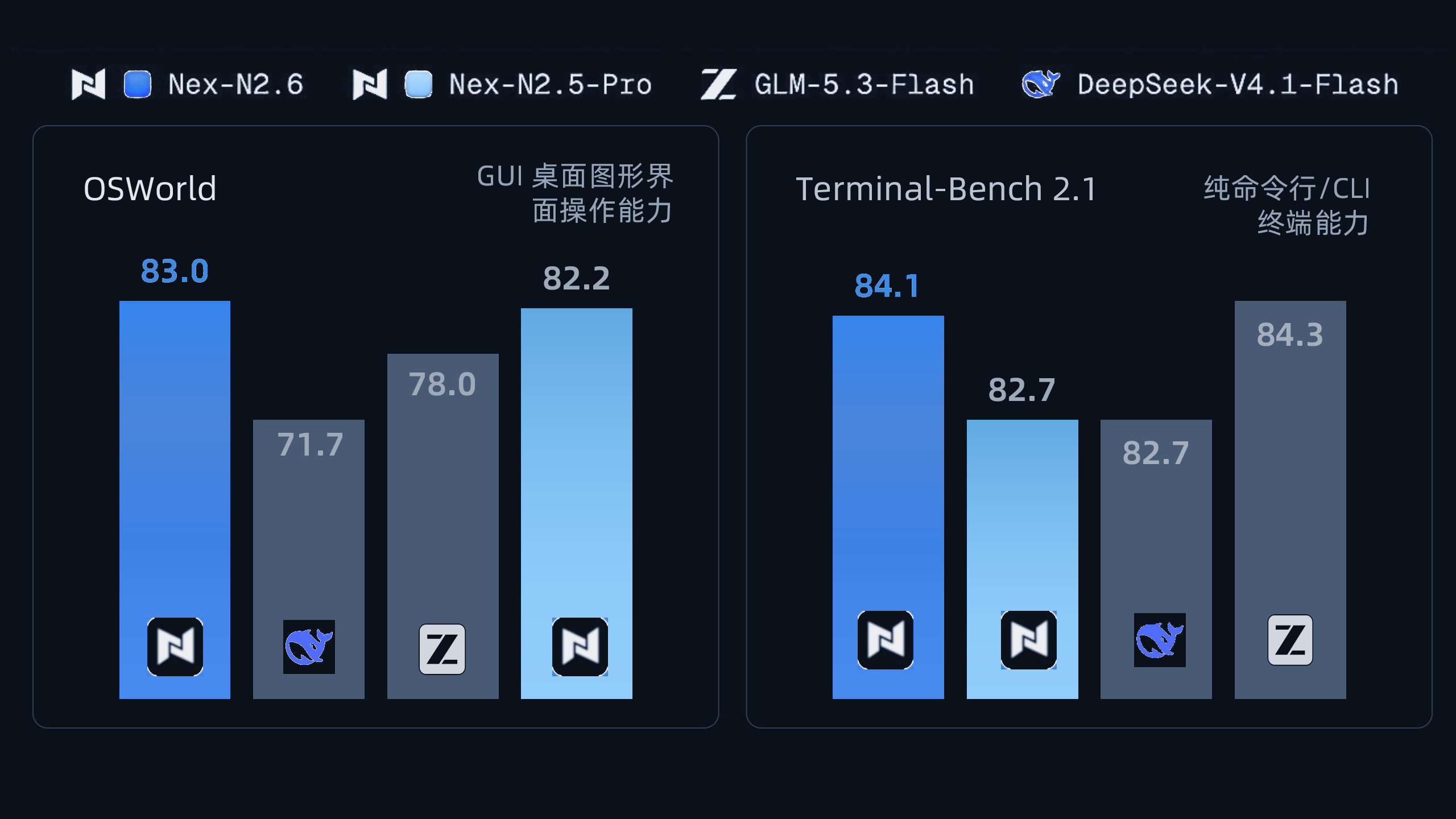
Nex-N2.6 scored 83.0 on the OSWorld desktop GUI benchmark, five points above its base model and above DeepSeek-V4.1-Flash in the reported comparison. It also scored 84.1 on Terminal-Bench 2.1. The team reports that the post-training recipe improved computer-use performance while addressing repeated reasoning and cross-framework overfitting without sacrificing general capabilities.
| Team-reported benchmark scores | GLM-5.3-Flash | DeepSeek-V4.1-Flash | N2.5-Pro | N2.6 |
|---|---|---|---|---|
| OSWorld (computer use) | 78.0 | 71.7 | 82.2 | 83.0 |
| Terminal-Bench 2.1 (terminal) | 84.3 | 82.7 | 82.7 | 84.1 |
| AutomationBench (automation) | 48.8 | 54.8 | 44.2 | 45.7 |
Demos
Case study: the first badge in Pokémon Platinum
Nex demonstrates long-horizon computer use across 468+ actions in Pokémon Platinum.
Using visual feedback and standard controls, it explores routes, handles wild encounters, selects moves, switches between Turtwig and Kricketot, manages HP and PP, levels up its team, and visits the Pokémon Center to recover.
Nex continues working through hundreds of changing game states. It observes the result of each action and chooses the next step toward a longer-term goal.
More computer-use examples
Nex organizes user data in Calc and creates charts in Impress, correcting series, backgrounds, and legends. It adds a note explaining why the two user categories cannot be added together, presenting five quarters of changes alongside the context needed to interpret them.
Starting with existing parts, Nex combines Blender scripts and interface operations to organize a scene, inspect render feedback, and refine its presentation. Open-top, exploded, and assembled views explain how the components relate.
Nex takes an aircraft concept from working files to presentable imagery. In Blender, it connects scripts, scenes, and camera settings, then checks documentation and outputs. The final sequence focuses on form, materials, and lighting in actual renders.
In Blender, Nex uses scripts to organize a scene, adjusts materials and viewing angles, and opens an actual render to inspect spatial relationships.
In FreeCAD, Nex creates parametric objects with scripts, changes dimensions, observes feedback, and restores the design. When the export API presents a limitation, it switches to the GUI to complete the handoff. Model details and drawings show the result while retaining the real inspection and adjustment process.
Nex turns observations into an analysis view that can be read and inspected further. In LabPlot, it organizes data columns, calculated values, and charts, corrects overlaid curves and layouts, then checks axes and reference lines. Observations, the model, and residuals appear on one page to support comparison, without independently validating statistical conclusions.
Nex turns a static image into an explorable geometric construction in GeoGebra. It establishes object relationships, adjusts colors and line styles, operates controls, observes feedback, and checks the saved result. The demonstration follows the actual process from construction to verification.
Vision2code
Nex can turn simple screenshots into complete mini-games.
Video2skills
Many agent tasks fail because personalized context is missing, rather than because the task itself is difficult. For example, requesting RMB 1,000 of company API credit requires knowing the company's platform, application entry point, account information, and approval process. Subject to the user's privacy permissions, Nex can learn from explicitly recorded demonstration videos or everyday screen observations, distill personal context from multimodal information, and generate personalized operating skills for computer-use agents such as NorthCUA or general-purpose agents such as OpenClaw.
Complex frontend development
In this LEGO city demo, Nex builds an interactive HTML frontend combining a city model, completion status, adjustable explosion radius, and keyboard shortcuts. Press E to destroy the city and R to rebuild it, demonstrating frontend design and interaction logic implemented by the model.
Nex builds an interactive 3D dungeon combat demo with WASD movement, mouse aiming, left-click attacks, skills on keys 1–4, and Shift to dash or dodge. Enemy waves, combos, upgrades, skill damage, and bosses provide a playable progression, demonstrating development from page construction through interaction logic and game mechanics.
Research agent: condensed matter physics
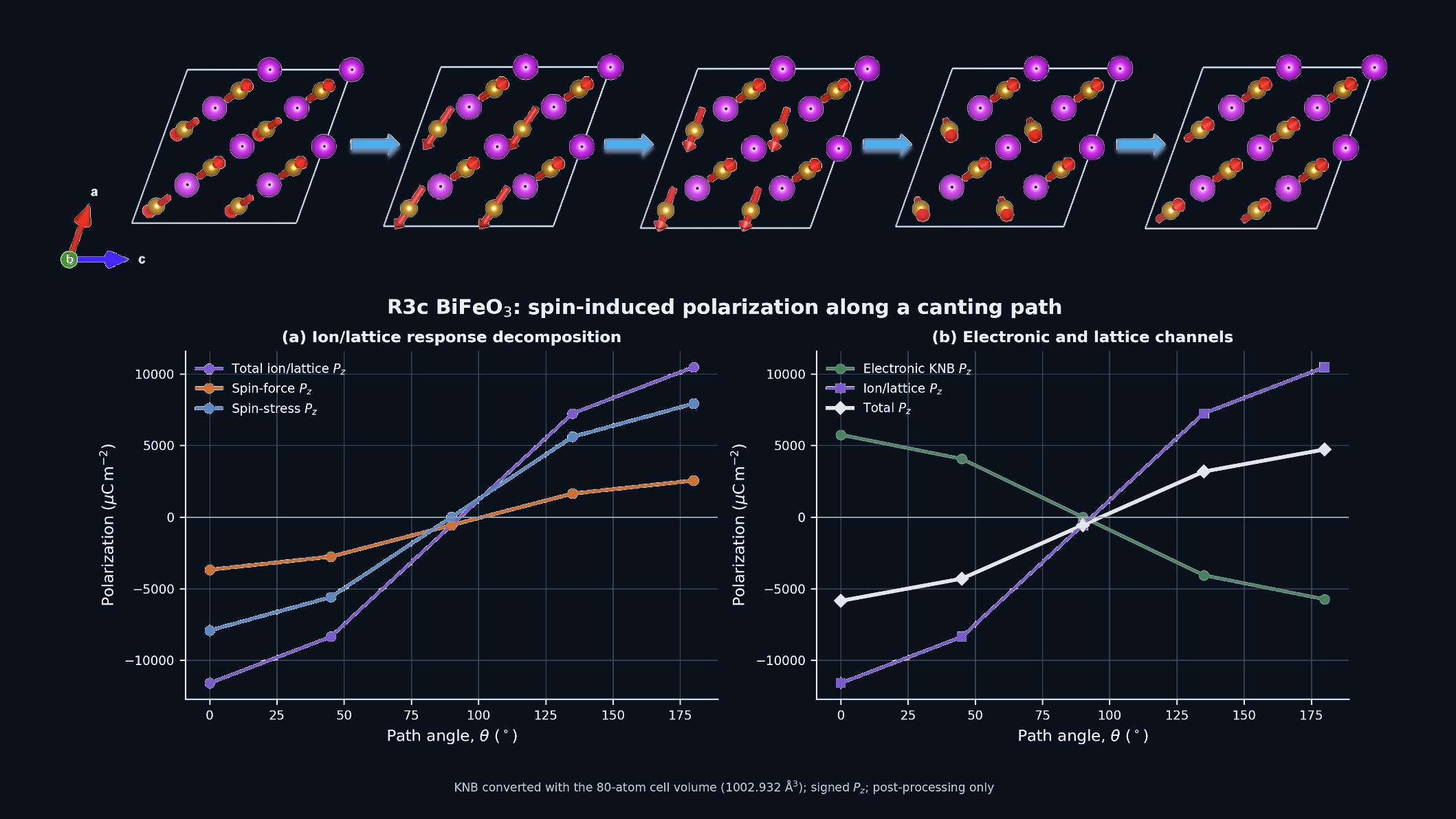
Nex simulates magnetoelectric coupling in R3c-phase BiFeO₃, examining changes in electric polarization under different magnetic-moment directions. It plots path angle against polarization to illustrate how polarization evolves as magnetic moments rotate, demonstrating magnetic-state control of electric polarization in the supplied simulation.
Productivity: chip design
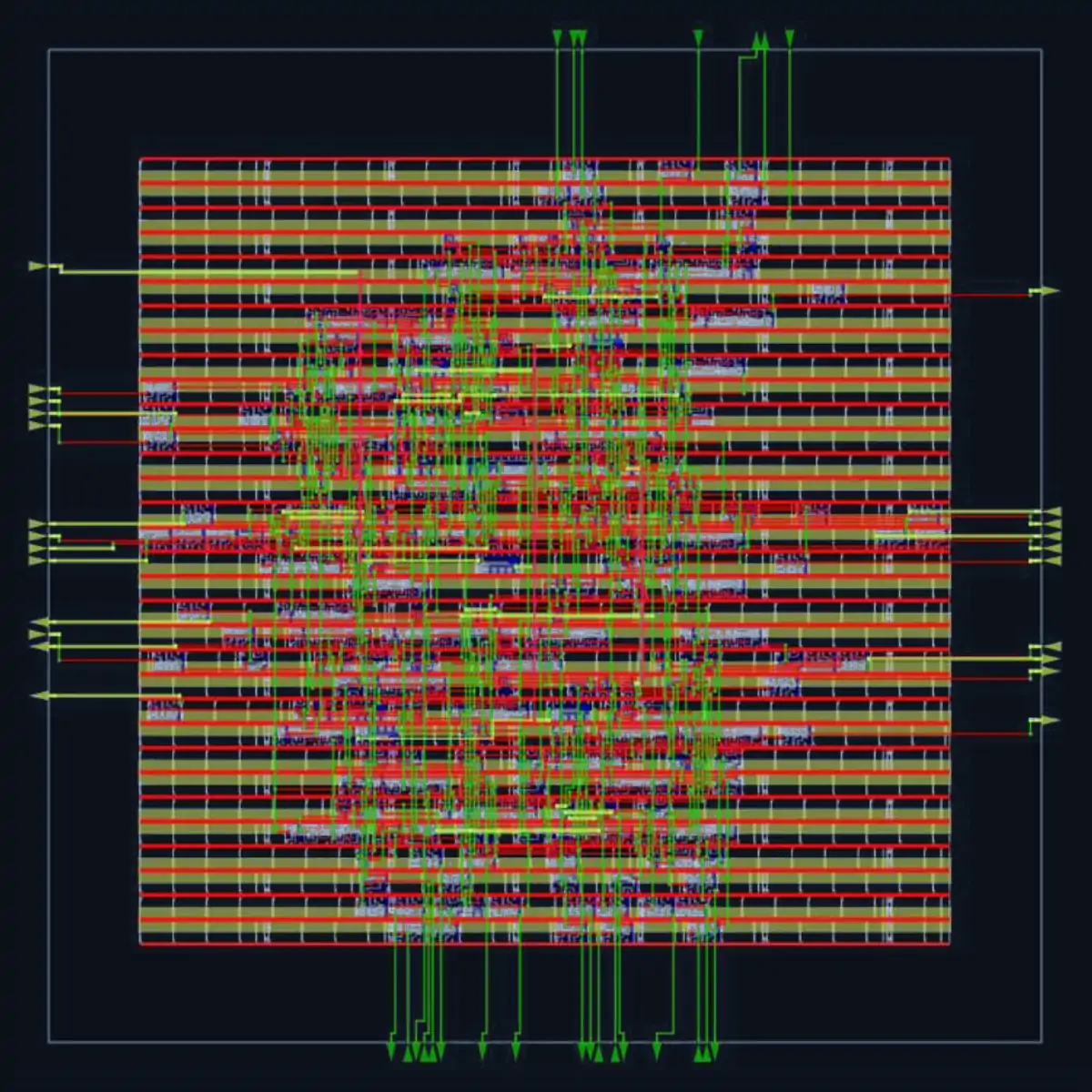
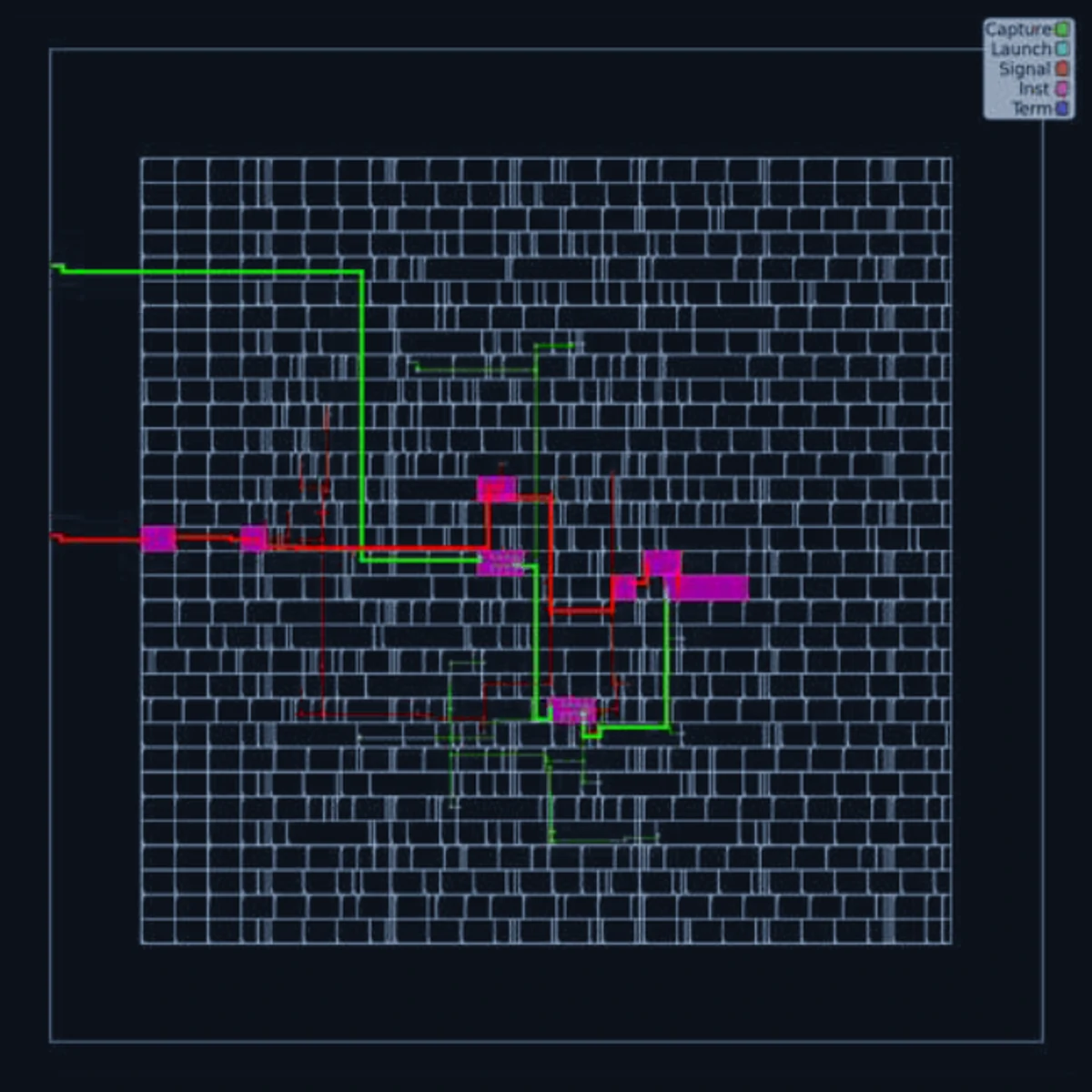
Nex repairs a defective CRC16-CCITT streaming accelerator RTL, correctly handling cycle-by-cycle data handshakes, busy state, the final byte, and a single-cycle completion signal. It then uses Verilator, Icarus Verilog, Yosys, and OpenROAD for an end-to-end workflow from functional verification and logic synthesis to Sky130HD placement and routing.
The supplied demonstration reports passing hidden functional regression and full physical implementation, producing GDS, DEF, SPEF, and a gate-level netlist. Setup and hold TNS are both zero, detailed-routing violations are zero, and the reported Fmax is approximately 386 MHz.